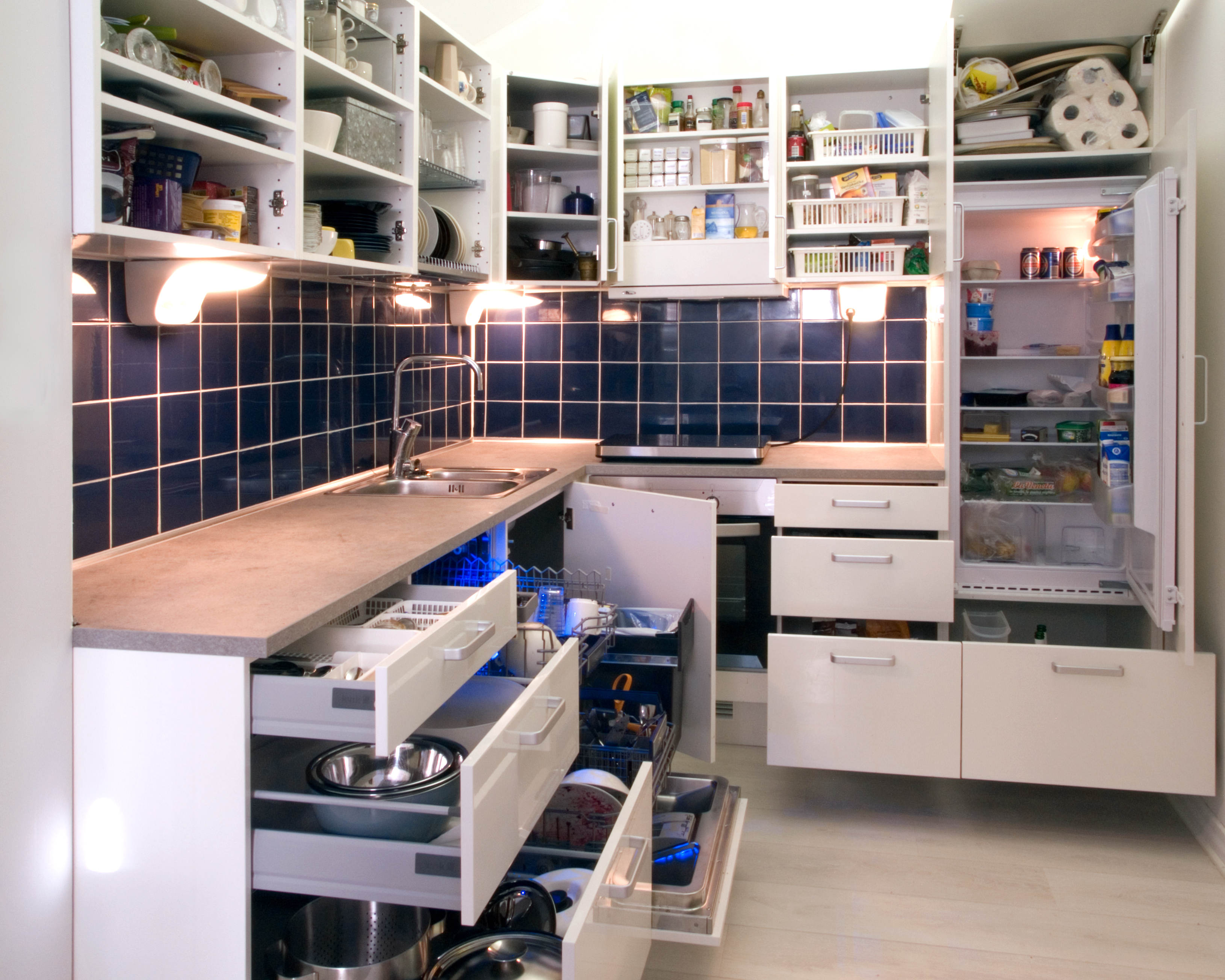
Most kitchen cabinet problems are not caused by too little storage. They are caused by contents that have no fixed location and gradually shift until the cabinet stops working. The steps below address this without requiring new purchases — though a few inexpensive additions at the end can help sustain the result.
Step 1: Empty the cabinet completely
Before assigning locations to anything, take everything out. Place items on the kitchen worktop grouped by type: pots, lids, baking dishes, canned goods, dry staples, glasses, and so on. This removes the bias that comes from trying to improve a cabinet while its contents remain inside.
At the same time, check expiry dates on packaged goods and remove anything unused for more than a year. The Polish standard for base cabinets is 60 cm wide and approximately 58 cm deep. Most have one or two fixed shelves. Note the actual internal height between shelves — this determines what can stand upright and what must lie flat.
Step 2: Sort by frequency of use
Divide the emptied items into three groups:
- Daily use — items reached for most days of the week.
- Weekly use — things used several times a week but not every day.
- Occasional use — specialist equipment used for a specific type of cooking, seasonal items, or items kept only as backups.
Daily-use items belong at eye level or just below it, and at the front of shelves. Occasional items can go behind other things or in the harder-to-reach corners of upper cabinets.
Step 3: Match items to cabinet types
Polish kitchen layouts typically follow a standard arrangement: base cabinets hold heavier items, upper cabinets hold lighter ones. Within that:
Base cabinets near the hob
Pots, pans, and lids belong here. Pans stack poorly when nested inside each other — lids fall, handles catch. A simple wire rack or even a plate rack placed vertically inside the cabinet lets pans stand on their sides with lids stored separately in the gap beside them. This is the single change that most noticeably reduces frustration when cooking.
Base cabinets under the worktop
Heavy appliances — stand mixers, slow cookers, grills — are stored here because of their weight, but are often hard to access. If an appliance is used weekly, it should sit at the front of the shelf with nothing in front of it. If it is used once a month, storing it at the back and placing everyday items in front is acceptable.
Upper cabinets near the hob
Oils, spices, and frequently used dry goods work well in upper cabinets next to the cooking area. The key constraint is depth: a 30 cm deep upper cabinet allows two rows of standard jars, but only if the back row is raised slightly so labels are visible. A small step riser — a piece of cut wood or a purchased shelf riser — solves this for very little cost.
Upper cabinets near the sink
Glasses, mugs, and plates are conventionally stored here for proximity to the drying rack. Stacking plates directly on a shelf works but creates instability when the column is more than six or seven plates high. Plate stands designed for this purpose cost little and make stacks both safer and easier to remove from.
- Base cabinet: 60 cm wide, 58 cm deep, 72 cm tall (without worktop)
- Upper cabinet: 60 cm wide, 30–35 cm deep, 60–72 cm tall
- Corner base cabinet: 90×90 cm with rotating carousel or pull-out system
- Standard shelf spacing: 28–32 cm between fixed shelves in upper cabinets
Step 4: Use the door space
Cabinet doors are almost always unused. Over-door racks designed for pantry doors fit most standard upper cabinet doors and add one or two rows of storage for small items. These are particularly useful for foil, cling film, and baking parchment rolls, which otherwise take up shelf space disproportionate to their weight.
Tension rods placed horizontally inside a lower cabinet create a grid that holds flat items such as chopping boards and baking trays vertically, preventing them from sliding and making individual pieces easy to retrieve.
Step 5: Return items with assigned positions
Each item going back into the cabinet should have a defined position. "Somewhere in this cabinet" is not a position. If two people use the kitchen, the positions should be agreed so items are returned correctly after washing.
A common Polish kitchen habit is to use the space above the refrigerator for less-used items. This works, but only if whatever is stored there is accessed no more than monthly — the height makes it genuinely inconvenient for anything else.
What actually requires a purchase
The method above produces noticeable improvements without buying anything. However, three categories of inexpensive items consistently help maintain organisation over time:
- Shelf risers — raise the back row in upper cabinets so labels are visible.
- Pan organisers — vertical racks that prevent nesting chaos.
- Clear bins or baskets — grouping loose items (snack packets, small jars, bags of dried goods) into a bin means the bin moves as a unit rather than individual items scattering.
The problem with most kitchen cabinets is not a lack of space. It is that nothing has a precise, fixed location — so every item placed inside has to be repositioned around other items every time it is used.
Maintaining the result
Cabinet organisation does not maintain itself. The most effective single habit is the "same place every time" rule: an item goes back to exactly where it came from, not approximately where there is space. In a household where this is followed consistently, reorganising a cabinet from scratch is rarely needed more than once a year.
See also: Choosing food storage containers for Polish kitchen shelves and Kitchen drawer organisation: inserts, trays, and dividers.